










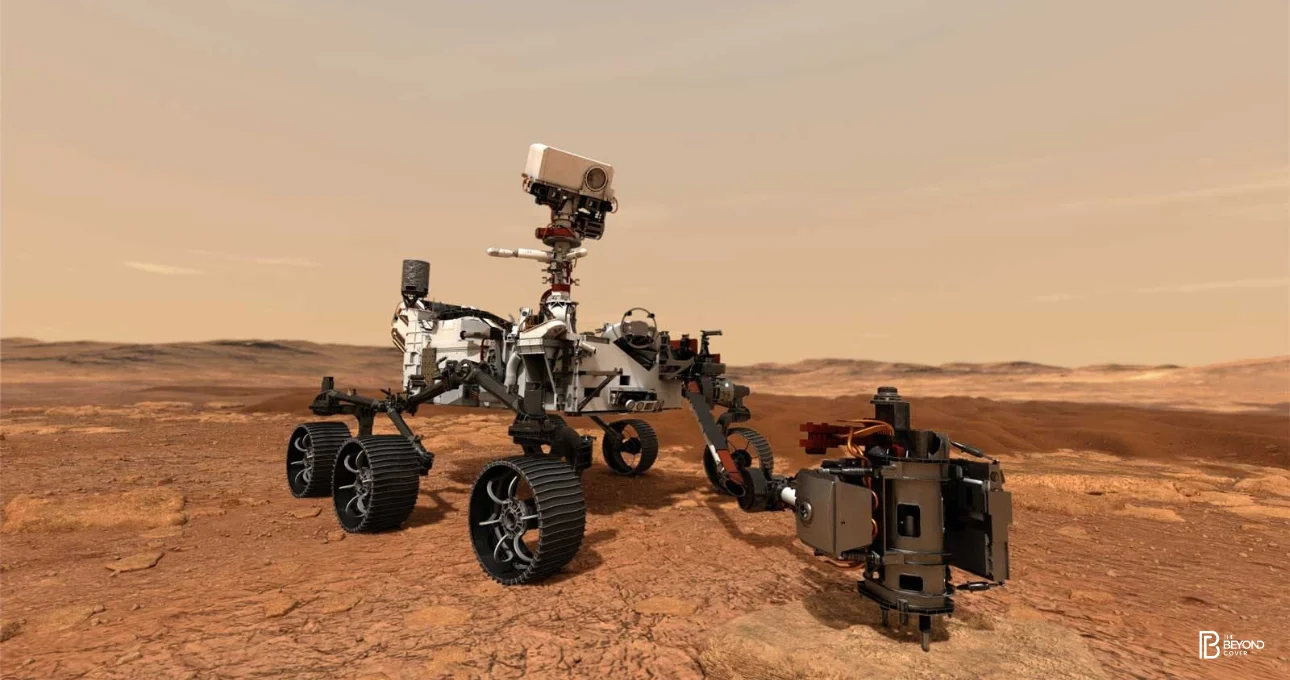
NASA’s Perseverance rover has reached a new milestone on Mars—not by handing over control to a chatbot, but by demonstrating how advanced AI reasoning systems, similar in capability to Anthropic’s Claude, could transform future planetary exploration. Recent research experiments and simulations involving large language model–style reasoning have shown how AI could assist rovers in planning, prioritising, and interpreting scientific tasks autonomously, marking a significant step forward in space robotics.
AI on Mars: What Actually Happened
Contrary to viral headlines, Anthropic’s Claude AI is not directly “driving” Perseverance on Mars. Instead, NASA researchers and academic collaborators have tested Earth-based AI systems inspired by large language models to evaluate how future missions could benefit from more autonomous decision-making.
These experiments explored how AI could analyse mission constraints, scientific goals, and environmental data—then recommend actions such as which rock samples to prioritise or when to adjust exploration routes. The findings point toward a future where rovers can make smarter, faster decisions without waiting for instructions from Earth.
Why Autonomy Matters for Mars Missions
Mars is, on average, more than 225 million kilometres away from Earth. Communication delays can range from 4 to 24 minutes one way, making real-time control impossible. Today, Perseverance relies on carefully planned command sequences created by scientists and engineers on Earth.
AI-driven autonomy could change that model. With advanced reasoning systems onboard or supporting mission planning, rovers could:
- Identify scientifically valuable targets on their own
- Adapt routes in response to unexpected terrain
- Optimise power usage and instrument scheduling
- Reduce the workload on Earth-based mission teams
These capabilities would be especially critical for future missions involving multiple robots or human exploration.
Claude-Style Reasoning and Space Exploration
Large language models like Claude are known for reasoning across complex instructions, maintaining context, and generating structured plans. NASA researchers are exploring how similar reasoning architectures—adapted for safety-critical systems—could support robotic explorers.
Rather than generating conversational responses, space-ready AI would focus on decision trees, risk assessment, and scientific prioritisation. These systems are trained and tested extensively in simulations before being considered for real-world use, ensuring reliability in harsh and unpredictable environments.
Perseverance’s Existing AI Capabilities
Perseverance already uses AI-driven tools such as AutoNav, which allows it to navigate Mars’ surface more efficiently than previous rovers. It can process images in real time to avoid hazards and choose safer paths.
The new research builds on this foundation, pointing toward higher-level autonomy—where the rover doesn’t just avoid obstacles but understands mission objectives and makes informed trade-offs.
Implications for Future Space Missions
The success of AI-assisted planning experiments has implications far beyond Perseverance. Upcoming missions to the Moon, Mars, and deep space could rely on similar systems to operate with minimal human intervention.
For NASA and other space agencies, this approach could:
- Enable longer, more complex missions
- Reduce operational costs
- Improve scientific output
- Support eventual human settlements beyond Earth
A Careful, Incremental Path Forward
NASA has emphasised that any use of advanced AI in space will follow a cautious, incremental approach. Safety, predictability, and verification remain top priorities, especially for missions costing billions of dollars.
While Claude itself isn’t running Perseverance, the research signals a clear direction: the future of space exploration will increasingly involve AI systems capable of reasoning, planning, and adapting alongside human scientists.
A Glimpse of Tomorrow’s Mars Exploration
Perseverance’s AI-driven experiments represent a glimpse into the next era of planetary science. As AI reasoning systems mature, they could become trusted partners in exploring worlds far beyond our reach—helping humanity move faster, smarter, and farther into the cosmos.