









From GPS-induced detours to notification fatigue, technology promised simplicity—but delivered a new kind of confusion. Here’s how we’re building tech to help humans survive… tech.
It’s a scene almost everyone has witnessed—or lived through.
A delivery agent stands outside your building, phone in hand, spinning slowly like a confused compass needle. A ride-hailing driver calls you for the third time: “Sir, where exactly are you?” The GPS, that once-magical digital guide, has sent them to the wrong gate, the wrong lane, the wrong apartment complex—or, in particularly dramatic cases, somewhere so far off it might as well be the Andaman Islands.
The irony is impossible to ignore. The very technologies designed to eliminate confusion are now creating it. And as our dependence on digital tools deepens, a curious trend is emerging: technology is now being built to help humans deal with technology itself.
Welcome to the age of meta-tech—tools designed not to replace humans, but to rescue them from their own smart devices.
The GPS Paradox: When Navigation Tools Stop Navigating
GPS was meant to be humanity’s answer to getting lost. No more unfolding paper maps. No more asking strangers for directions. Just follow the blue line.
Yet today, GPS confusion is so common that it’s practically a cultural joke.
Why does this happen?
- Over-precision without context: GPS can locate you within meters, but it doesn’t understand human landmarks like “the blue gate” or “the building behind the temple.”
- Outdated or incorrect mapping data: Roads that no longer exist, new buildings that aren’t mapped, or private lanes mistaken for public roads.
- Blind trust in the algorithm: Many drivers follow GPS instructions even when common sense suggests otherwise—down staircases, into lakes, or through locked gates.
The result is frustration on both ends: drivers overwhelmed by digital instructions and customers exhausted by constant clarification calls.
This is not a failure of humans alone. It’s a failure of human-centered design.
Digital Stress: The Hidden Cost of Smart Living
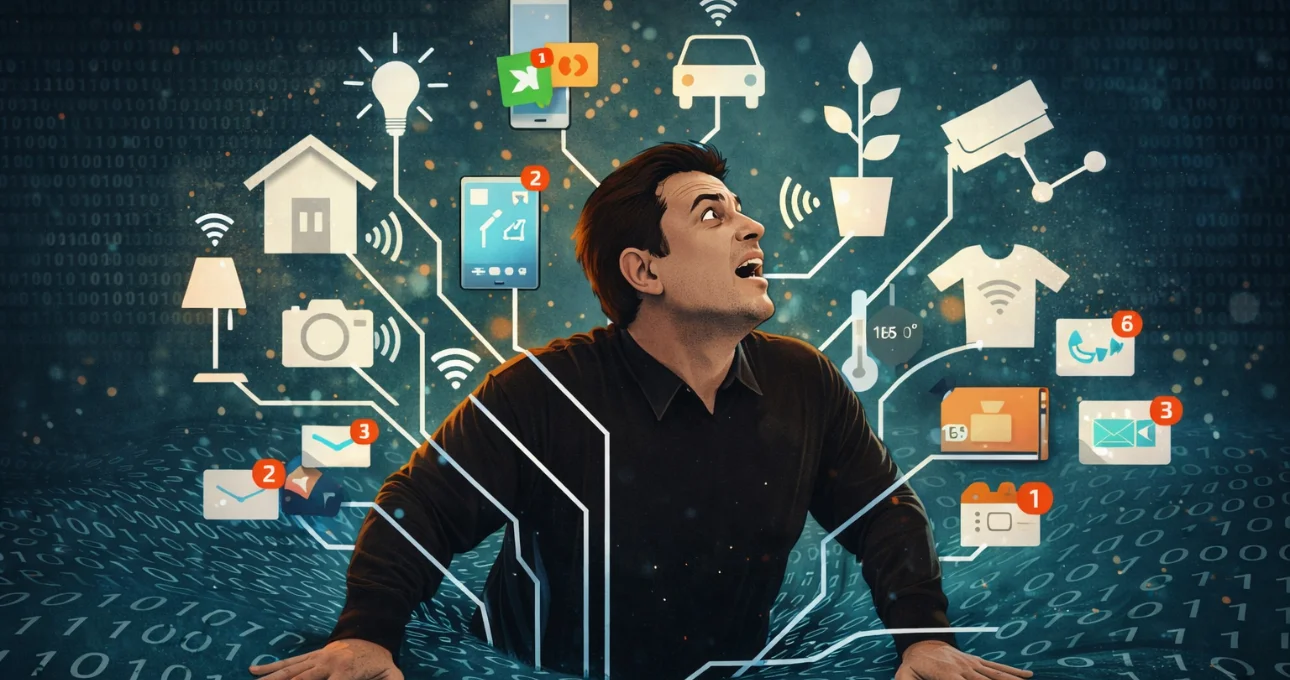
Navigation errors are just one symptom of a larger issue. Modern technology has quietly added cognitive load to everyday life.
Consider the average person’s day:
- Dozens of notifications competing for attention
- Multiple apps for the same task
- Constant updates, changes, and new interfaces
- Passwords, OTPs, PINs, biometric failures
- Automated systems that refuse to understand nuance
Instead of simplifying life, tech often demands continuous learning and adjustment. This leads to what psychologists now call digital fatigue or tech stress.
Ironically, as technology becomes “smarter,” humans are expected to work harder just to keep up.
Why Tech Often Fails Humans
At the heart of the problem lies a simple truth:
Technology is optimized for efficiency, not empathy.
Most systems are designed around ideal scenarios, not messy human realities. They assume:
- Stable internet connections
- Perfect understanding of interfaces
- Accurate data inputs
- Calm, patient users
But real life is noisy, emotional, rushed, and unpredictable.
A delivery driver may be tired, under time pressure, and unfamiliar with a neighborhood. A senior citizen may struggle with app updates. A visually impaired user may find touchscreens hostile.
When tech ignores these realities, it stops serving humans—and starts demanding obedience from them.
The Rise of Human-Centered Tech
In response, a new wave of innovation is gaining momentum: technology designed to adapt to humans, not the other way around.
Here’s how this shift is taking shape.
1. Smarter Maps That Think Like Humans
Mapping platforms are slowly evolving beyond abstract coordinates.
New features include:
- Landmark-based navigation: Directions like “turn left after the pharmacy” instead of “turn left in 30 meters.”
- Community-edited locations: Locals correcting map errors in real time.
- Multiple pin systems: Separating building entrances, parking gates, and delivery points.
- Voice notes and photos attached to locations: Helping drivers visualize destinations.
Some logistics companies now use custom micro-maps for housing societies, malls, and office complexes—because generic GPS simply isn’t enough.
2. Tech That Explains Itself
One of the biggest frustrations with modern devices is silence. When something goes wrong, systems rarely explain why.
Human-friendly tech changes that by:
- Using plain language error messages
- Offering step-by-step guidance instead of codes
- Providing contextual help exactly when users need it
- Using visuals instead of text-heavy instructions
Instead of “Location not supported (Error 402),” imagine a message saying:[Text Wrapping Break]“We can’t find the right entrance. Could you move closer to the main gate or share a nearby landmark?”
Small changes. Massive relief.
3. AI as a Translator Between Humans and Machines
Artificial intelligence is increasingly being used not to replace humans—but to interpret human behavior.
Examples include:
- AI that detects confusion based on repeated actions and offers help
- Voice assistants that understand accents, hesitation, and emotion
- Chatbots that escalate to humans when conversations get stuck
- Systems that learn user habits and adapt interfaces accordingly
In navigation, AI can analyze where drivers frequently get lost and proactively adjust routes or prompts.
The goal? Make tech less rigid and more forgiving.
Digital Literacy: The Missing Link
Even the best-designed tools fail without proper understanding.
Digital literacy today is as essential as reading and writing—but far less evenly distributed.
Delivery agents, gig workers, seniors, and first-time smartphone users are often expected to use complex apps with minimal training.
Some promising solutions include:
- In-app micro-training videos
- Language localization beyond English
- Icon-based interfaces for low-literacy users
- Offline functionality for unreliable networks
When people understand tech, they fear it less—and use it better.
Why This Matters More Than Ever
As cities grow denser and services become increasingly app-based, small inefficiencies scale into massive problems.
- A few wrong turns multiplied by thousands of deliveries
- A confusing interface used by millions
- A poorly designed update rolled out overnight
The cost isn’t just inconvenience—it’s time, money, mental health, and trust.
When users lose trust in technology, adoption suffers. When workers struggle with tools, productivity drops. When systems ignore human behavior, everyone pays.
Designing for the Messy Middle
The future of technology does not lie in making machines smarter alone—but in making them more human-aware.
This means designing for:
- Confusion, not just clarity
- Mistakes, not perfection
- Emotion, not just logic
- Diversity, not averages
It means acknowledging that humans will misread, misunderstand, forget, panic, and improvise—and building systems that support them anyway.
From Digital Compass to Digital Companion
Technology was never meant to be an alien force we wrestle with. At its best, it’s an invisible helper—quietly guiding, gently correcting, patiently adapting.
The delivery agent shouldn’t have to fight their GPS.
The driver shouldn’t have to call five times.
The user shouldn’t feel stupid for not understanding an app.
As we move forward, the most powerful innovation may not be faster processors or smarter algorithms—but kinder technology.
Tech that understands humans are imperfect.[Text Wrapping Break]Tech that meets us where we are.[Text Wrapping Break]Tech that helps us deal with… tech.
And maybe then, the blue dot will finally lead us home.