










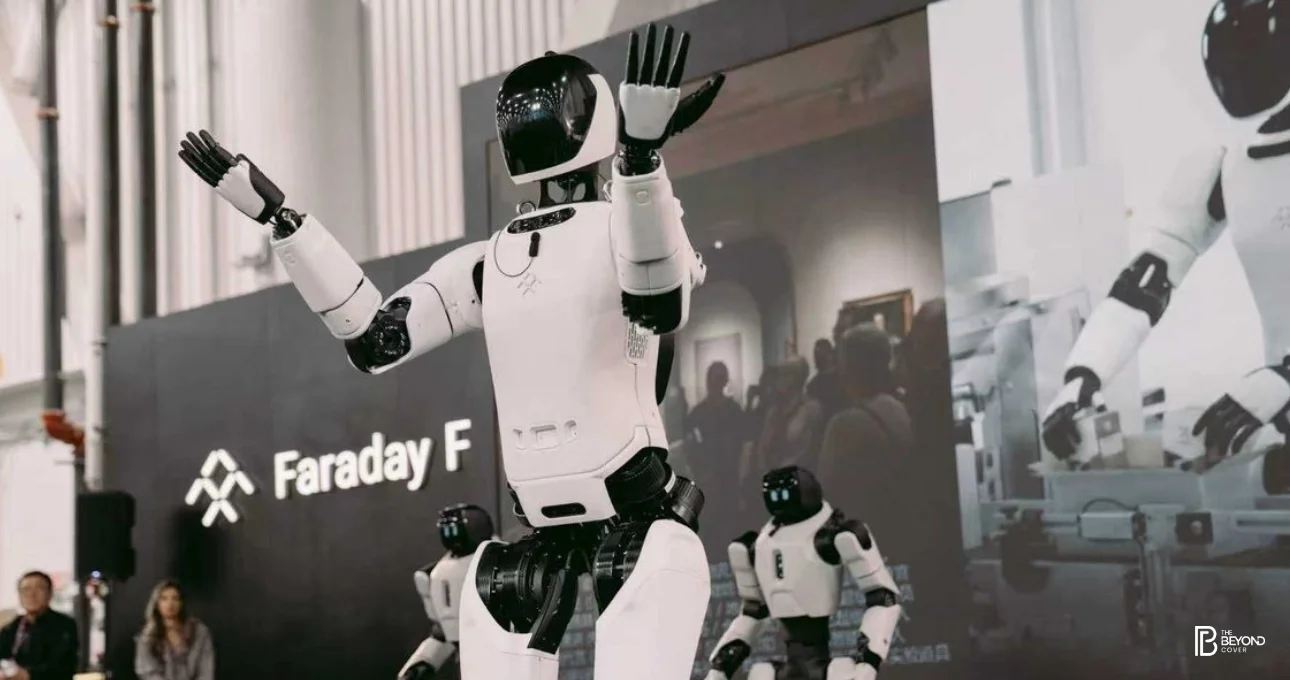
Electric vehicle startup Faraday Future has officially entered the robotics space with the launch of its first series of multipurpose AI-powered humanoid and bionic robots, marking a significant expansion beyond automobiles. The move highlights how advanced AI, robotics, and mobility technologies are increasingly converging as companies look to diversify and future-proof their innovation strategies.
Faraday Future’s Expansion Beyond Electric Vehicles
Faraday Future, best known for its luxury electric vehicles, announced that its new humanoid and bionic robots are designed to operate across industrial, commercial, and service-oriented environments. The company positions the robots as intelligent physical agents capable of performing real-world tasks that require mobility, perception, and interaction with humans.
This strategic shift reflects a broader trend among EV and deep-tech companies that are repurposing expertise in sensors, AI software, battery systems, and autonomous control into robotics and physical AI applications.
AI-Powered Humanoid and Bionic Robot Capabilities
According to Faraday Future, the newly launched robots leverage advanced artificial intelligence, machine vision, and motion-control systems to perform a wide range of tasks. These include object manipulation, navigation in dynamic environments, and basic human interaction.
The robots are described as “multipurpose,” meaning they can be adapted for use in manufacturing facilities, logistics hubs, retail spaces, healthcare support roles, and research environments. Their bionic design emphasizes human-like movement and dexterity, enabling them to work in spaces built for people rather than requiring specialized infrastructure.
Why Robotics Fits Faraday Future’s Technology Stack
Faraday Future’s robotics push builds on core competencies developed in the electric vehicle sector. Technologies such as autonomous driving algorithms, sensor fusion, real-time decision-making, and energy-efficient power systems translate naturally into humanoid robotics.
By leveraging its existing AI and hardware expertise, the company aims to shorten development cycles and reduce costs compared to robotics startups building systems from scratch. This approach mirrors similar strategies adopted by global tech companies entering the humanoid robot market.
Target Use Cases and Industry Demand
The launch comes amid rising global interest in humanoid and bionic robots as labor shortages, rising costs, and safety concerns drive demand for automation. Faraday Future has indicated that its robots are intended to support—not replace—human workers by handling repetitive, physically demanding, or hazardous tasks.
Potential applications include warehouse operations, factory assistance, customer-facing service roles, and facility management. As AI-powered robots become more capable, enterprises are increasingly exploring pilot deployments to assess productivity and return on investment.
Competition in the Humanoid Robotics Market
Faraday Future’s entry places it in a competitive landscape that includes established robotics firms and tech giants investing heavily in physical AI. The market is still in its early stages, with most humanoid robots undergoing testing, limited deployments, or research-focused use.
Success will depend on reliability, cost efficiency, safety, and the ability to scale production—areas where Faraday Future’s manufacturing background could provide an advantage.
Long-Term Vision for Physical AI
The company has framed the robot launch as part of a longer-term vision centered on AI-driven intelligent mobility, extending from vehicles to autonomous systems operating in physical environments. By positioning robots as platforms rather than single-purpose machines, Faraday Future aims to build an ecosystem that can evolve through software upgrades and AI model improvements.
A Strategic Bet on the Future of Robotics
While it remains early days, Faraday Future’s humanoid and bionic robot launch underscores how quickly AI and robotics are reshaping traditional industries. As physical AI moves from labs into real-world deployment, companies that can integrate intelligence, hardware, and scalable production may gain a critical edge.
For Faraday Future, the move into robotics represents both a diversification strategy and a bold bet on a future where intelligent machines operate seamlessly alongside humans across industries.