










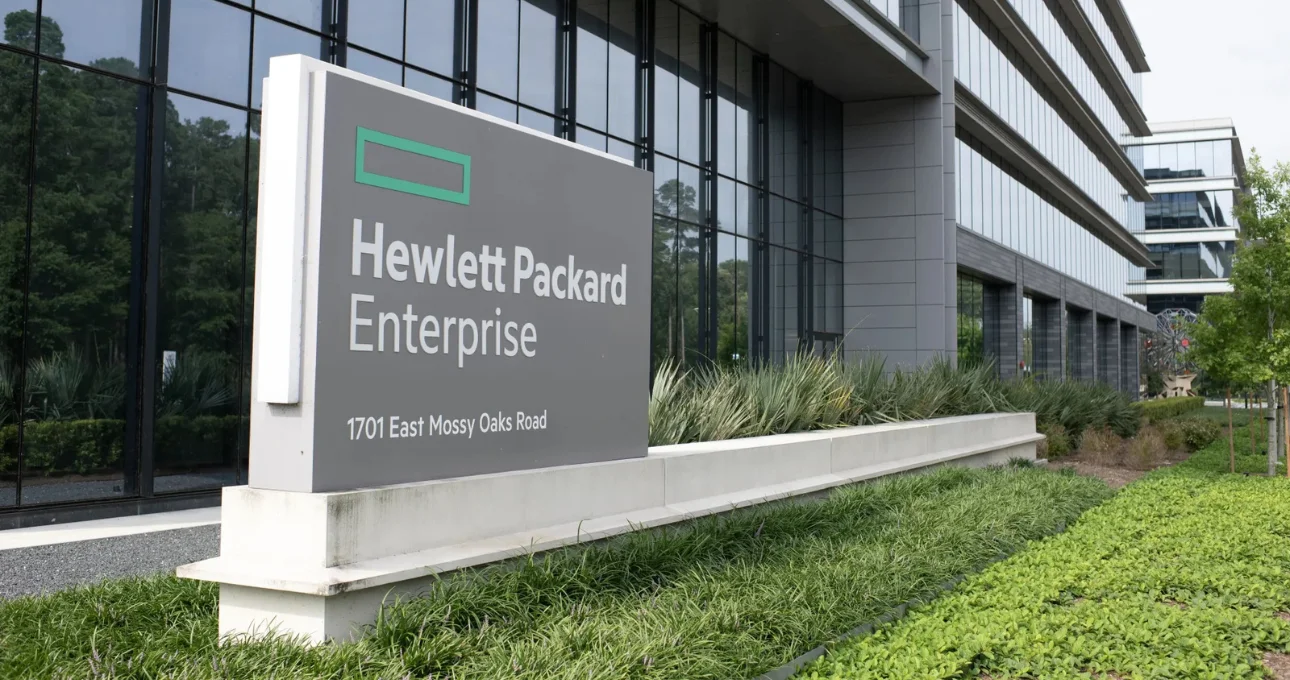
Hewlett Packard Enterprise (HPE) is deepening its play in hyperscale AI infrastructure with the adoption of AMD’s Helios AI rack-scale architecture, marking a major shift in how cloud service providers (CSPs) can deploy and scale large AI workloads. The offering integrates AMD Instinct accelerators, open compute standards, and high-bandwidth Ethernet networking — giving cloud platforms a flexible, energy-efficient foundation to train and run advanced AI models at massive scale.
As demand for large language models (LLMs), multimodal systems, and agentic AI skyrockets, hyperscalers are increasingly moving toward open rack-scale designs that offer better density, easier maintenance, and consistent performance across huge clusters. HPE’s integration of AMD Helios positions the company as a key supplier for CSPs looking to build AI supercomputing capabilities without relying solely on proprietary architectures.
Why AMD Helios Matters for the Future of AI Clusters
The Helios platform represents AMD’s most ambitious attempt to redefine the data-center design stack. It delivers:
Rack-Scale Modularity
Helios is built as a fully integrated rack solution, allowing CSPs to deploy AI infrastructure faster and with fewer engineering complexities.
Dense Compute Powered by AMD Instinct
With Instinct MI300 accelerators at its core, Helios offers high compute throughput while maintaining power efficiency — a crucial factor as energy costs rise globally.
Integrated High-Speed Ethernet Networking
Unlike proprietary interconnects, Helios emphasizes open Ethernet-based networking, simplifying multi-vendor deployments and improving interoperability across cloud environments.
Designed for Large AI Models
The architecture is optimized for AI workloads requiring extreme memory and compute bandwidth, including LLM training, fine-tuning, inference scaling, and distributed agent-based systems.
How HPE Is Bringing Helios to Cloud Service Providers
By adopting Helios, HPE can deliver turnkey AI racks tailored for CSPs that need to stand up large GPU clusters quickly. This integration means:
1. Faster Deployment of AI Clouds
HPE’s manufacturing and integration expertise significantly reduces time-to-deployment for AI training environments.
2. Predictable Performance at Scale
Helios was engineered to ensure consistent results across thousands of nodes — critical for large AI training pipelines and generative workloads.
3. Open, Vendor-Neutral Infrastructure
HPE’s open architecture approach appeals to CSPs that want to avoid vendor lock-in and maintain flexibility in GPU, networking, and storage choices.
4. Better Economics for High-Density AI Computing
By using open standards and energy-efficient hardware, Helios racks lower total cost of ownership over time — a key advantage compared to proprietary GPU stacks.
Why Cloud Providers Are Paying Attention
The AI boom has created an unprecedented surge in demand for compute, pushing cloud providers to diversify away from a GPU-only strategy. With AMD gaining traction due to supply availability and competitive performance, CSPs see Helios as a strategic alternative for scaling generative AI infrastructure.
HPE’s global distribution and support ecosystem adds reliability and stability, making it easier for cloud companies — from hyperscalers to regional AI clouds — to adopt and expand AMD-powered deployments.
The Bottom Line
HPE’s decision to bring AMD’s Helios rack-scale AI architecture to CSPs signals a broader industry shift toward more open, modular, and scalable AI infrastructure. As enterprises accelerate adoption of generative AI and agent-based systems, cloud platforms need new ways to build cost-effective, high-performance AI clusters.
With Helios, HPE is positioning itself as a central player in that future — helping cloud providers deploy the next wave of AI supercomputing with greater speed, flexibility, and efficiency.